If you’re planning to launch a cosmetics brand and sourcing your products from a European manufacturer, understanding EU cosmetics regulations before you bring a single SKU to market is essential. The European Union maintains one of the strictest cosmetics regulatory frameworks in the world, governing formulation safety, labeling requirements, ingredient restrictions, and post-market surveillance. The good news: working with a GMP-certified EU manufacturer means most of the compliance groundwork is already built into the process.
This guide covers the core requirements of EU cosmetics regulations, what they mean for your brand, and how Cosmetic Lab handles compliance as your manufacturing partner in Latvia.

Table of Contents
What Are EU Cosmetics Regulations?
EU cosmetics regulations refer primarily to Regulation (EC) No 1223/2009, the legislative framework governing cosmetic products sold within the European Economic Area (EEA) since July 2013. It replaced the earlier Cosmetics Directive 76/768/EEC and introduced a harmonized approach to cosmetics safety across all EU member states.
Under EU cosmetics regulations, a “cosmetic product” is any substance or mixture intended to be applied to the external parts of the human body (skin, hair, nails, lips) or to the teeth and mucous membranes of the oral cavity, for the purpose of cleaning, perfuming, protecting, or changing appearance. This definition covers face creams, shampoos, deodorants, lipsticks, nail polishes, sunscreens, and toothpastes.
The regulation is enforced by national competent authorities in each EU member state and applies to any product placed on the EU market, regardless of where it was manufactured.
The Core Framework: Regulation (EC) No 1223/2009
Regulation (EC) No 1223/2009, commonly referred to as the EU Cosmetics Regulation, establishes a single legal framework for cosmetics safety and marketing across all 27 EU member states. Its core principles are:
Safety by design: Every cosmetic product must be demonstrably safe for human health under normal or reasonably foreseeable conditions of use before it is placed on the market. Safety is evaluated through a mandatory Cosmetic Product Safety Report (CPSR) prepared by a qualified assessor.
Responsible Person: There must be a designated Responsible Person (RP) established within the EU who takes legal responsibility for the product’s compliance.
Transparency and traceability: Products must carry complete labeling information, and a Product Information File (PIF) must be maintained and made available to regulatory authorities on request.
Post-market surveillance: Serious undesirable effects must be reported to competent authorities, and all adverse effects must be documented.
Key Requirements Under EU Cosmetics Regulations
1. Cosmetic Product Safety Report (CPSR)
The CPSR is the cornerstone of EU cosmetics compliance. It must be prepared by a qualified cosmetic safety assessor (typically a toxicologist or pharmacist) and covers two parts:
Part A (Safety Information) describes the product’s quantitative and qualitative composition, physico-chemical properties, microbiological quality, impurities, packaging materials, and clinical evidence of safety.
Part B (Safety Assessment) contains the assessor’s conclusions on the product’s safety for human health, including an exposure assessment and evaluation of any identified risks. Without a completed CPSR, a product cannot legally be placed on the EU market.
2. Responsible Person (RP)
Every cosmetic product sold in the EU must have a designated Responsible Person, an individual or company established within the EU who ensures the product meets all regulatory requirements. The Responsible Person files the CPNP notification, maintains the PIF, reports serious undesirable effects, and ensures labeling and claims comply with EU cosmetics regulations.
For non-EU brands importing into the European market, appointing an EU-based RP is a legal requirement. When you source products from Cosmetic Lab, we can discuss acting as your Responsible Person or help you appoint one.
3. CPNP Notification
Before a cosmetic product is placed on the EU market, it must be notified through the Cosmetic Products Notification Portal (CPNP): the EU’s centralized online notification system. Notification is free of charge and must be completed before the product goes on sale. The notification includes the product name, category, country of first placing on market, frame formulation reference, and Responsible Person contact details.
4. Product Information File (PIF)
The Responsible Person must maintain a Product Information File for each cosmetic product for ten years after the last batch is placed on the market. The PIF contains the product description, CPSR, manufacturing method and GMP compliance declaration, proof of claimed effects, and any human volunteer studies. It must be accessible to competent authorities on request.
5. Labeling Requirements
EU cosmetics regulations require specific information to appear on the product and its outer packaging:
Mandatory label elements include: name and address of the EU Responsible Person; country of origin for imported products; net content by weight or volume; minimum durability date or period-after-opening (PAO) symbol; precautions for use; batch number for traceability; product function; and the full ingredient list in INCI nomenclature.
What EU Cosmetics Regulations Mean for Your Brand
If you’re a brand based outside the EU, for example in the US, the UK (post-Brexit), Australia or Canada, EU cosmetics regulations affect your products directly if you plan to sell to European consumers or source products from a European manufacturer. Key implications:
Pre-market compliance is mandatory. Unlike the US FDA framework, which is largely self-regulatory, EU cosmetics regulations require a completed safety assessment before any product reaches the market. There is no post-market catch-up route.
An EU presence is required. You must appoint an EU Responsible Person. This can be your manufacturer, an appointed distributor, or a specialized RP service.
Documentation must be maintained. The Product Information File must be kept for ten years and be accessible to authorities. This is not optional.
Even if you’re only selling in the US or Australia, understanding EU cosmetics regulations is strategically valuable: the EU’s standards are widely recognized as a global quality benchmark, and EU-compliant documentation often supports regulatory approval in other markets.
Restricted and Prohibited Ingredients Under EU Cosmetics Regulations
EU cosmetics regulations maintain extensive annexes listing restricted and prohibited substances:
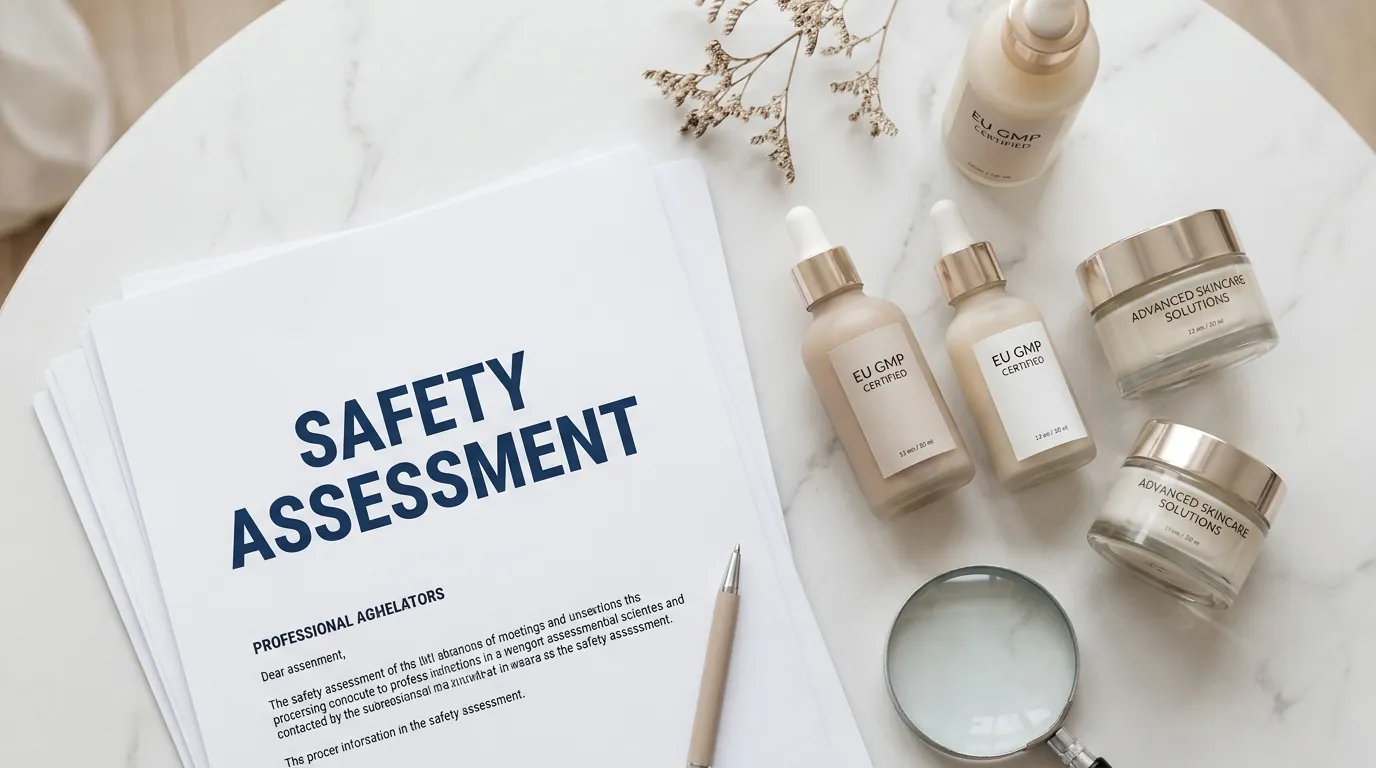
Annex II contains over 1,300 substances prohibited from use in cosmetic products. Annex III lists substances that may be used only within specified concentrations or conditions. Annexes IV, V, and VI set out permitted colorants, preservatives, and UV filters respectively, each within defined limits.
The EU bans a significantly broader range of ingredients than the US FDA, including several parabens above set concentrations, formaldehyde-releasing preservatives above threshold levels, and over 80 fragrance allergens that must be declared or are restricted at certain concentrations. When you source through Cosmetic Lab, our formulation team works exclusively within EU-approved ingredient lists from day one.
How Working with a GMP-Certified EU Manufacturer Simplifies Compliance
One of the most significant advantages of sourcing through a GMP-certified EU cosmetics manufacturer is that compliance is built into the process from day one. At Cosmetic Lab, our manufacturing facility in Latvia operates under ISO 22716 (Good Manufacturing Practice for Cosmetics) and is audited to EU regulatory standards. This means:
Every formulation is developed with EU-compliant ingredients and concentrations. CPSR documentation is prepared with support from qualified safety assessors. CPNP notification support is available for brands placing products on the EU market. Product Information Files are prepared and maintained as part of our service. GMP-certified production ensures microbiological safety and batch consistency across every production run.
If you’re a non-EU brand working with Cosmetic Lab through our private label or contract manufacturing service, we manage the technical compliance layer so you can focus on your brand’s positioning and distribution.
EU Cosmetics Regulations vs. US FDA Requirements
EU and US cosmetics regulations take fundamentally different approaches to safety. Under EU cosmetics regulations, pre-market safety assessment is mandatory: no product may be placed on the market without a completed CPSR. The EU has banned or restricted approximately 2,500 ingredients.
Under the US FDA framework, cosmetics are largely self-regulated; there is no pre-market approval requirement, and the FDA has formally restricted fewer than 30 cosmetic ingredients. The Modernization of Cosmetics Regulation Act (MoCRA) of 2022 introduced new registration and facility requirements, but the US framework remains considerably less prescriptive than the EU’s.
For brand owners in the US, UK, Australia, and Canada, sourcing from an EU-certified manufacturer provides an internationally recognized safety baseline that often simplifies documentation for other markets.
Frequently Asked Questions: EU Cosmetics Regulations
Do EU cosmetics regulations apply to products manufactured outside the EU?
Yes. EU cosmetics regulations apply to any product placed on the EU market, regardless of where it was manufactured. A US or Australian brand selling to European consumers must ensure its products comply with EU requirements.
Is a Responsible Person required for every product sold in the EU?
Yes. Every cosmetic product placed on the EU market must have a designated Responsible Person established within the EU. If your brand is based outside the EU, you must appoint an EU-based RP, or work with a manufacturer or distributor who fulfills this role.
Do UK cosmetics regulations differ from EU regulations after Brexit?
Post-Brexit, the UK operates its own retained cosmetics regulation that largely mirrors EU requirements. Products sold in both the EU and UK require separate Responsible Persons and separate product notifications, through CPNP for the EU and the OPSS portal for the UK.
How long does it take to complete a CPSR?
Typically 4–8 weeks, depending on formulation complexity and the safety assessor’s workload. At Cosmetic Lab, CPSR preparation is integrated into our product development timeline.
Can Cosmetic Lab act as my EU Responsible Person?
We can discuss this arrangement with you directly. Contact our team to understand the options available for your product category and target market.
Ready to launch EU-compliant cosmetics with a certified manufacturer behind you? Cosmetic Lab’s team is ready to guide you through private label, contract manufacturing, and full regulatory compliance from formulation to shelf.
Importing cosmetics from Europe is simpler than most brands outside the EU expect. If you are based in the US, UK, Australia, Canada, or the Gulf region and want to source private label cosmetics from Europe (whether white label, custom OEM, or branded private label) this guide covers the process step by step: from finding a manufacturer to clearing customs and getting your product to market.
Table of Contents
Step 1: Find and Qualify a European Cosmetics Manufacturer
The first step when sourcing private label cosmetics from Europe is qualifying a manufacturer. The key criteria to verify:
- GMP certification (ISO 22716): mandatory for EU manufacturers: ask for the certificate.
- Export experience: has the manufacturer shipped to your target market before? Ask for the markets they have exported to and what documentation they provide.
- Product range match: does the manufacturer produce the product category you need: skincare, haircare, bath, solid cosmetics, organic-certified?
- MOQ alignment: confirm minimum order quantities before investing in samples. EU manufacturers typically offer MOQ from 1,000 units per SKU.
Step 2: Request Samples and Approve Formulas
Once you have identified a manufacturer, the next step is sampling. For white label products (adapting an existing formula with your branding), a sample can typically be ready within one to two weeks. For custom OEM formulation from scratch, allow 4–8 weeks for the first prototype; this covers ingredient sourcing, development, and initial stability assessment.
Sample evaluation should cover: texture, fragrance, colour, stability under typical transport and storage conditions, and, if you are targeting specific claims, performance testing. Once the sample is approved, you proceed to production order.
Step 3: Production and Export Documentation
After sample approval, production is confirmed with a purchase order and deposit. Lead times for production runs typically range from 4–8 weeks depending on volume, formula complexity, and packaging lead times. During this phase, your manufacturer should be preparing the export documentation package that you will need to import cosmetics from Europe into your target market.
The standard documentation package from a reputable EU manufacturer includes:
- Certificate of Analysis (COA): batch-specific test results confirming the finished product meets its specification for appearance, pH, viscosity, microbial limits, and other relevant parameters.
- Safety Data Sheet (SDS/MSDS): required for customs classification in most markets. Classifies the product for transport and storage safety.
- Free Sale Certificate: issued by the relevant EU authority, confirms the product is legally manufactured and freely sold in the EU. Required for import registration in Gulf markets (GCC), many Southeast Asian markets, and parts of Latin America.
- GMP Certificate: confirms manufacturing under ISO 22716. Required or strongly recommended for import clearance in the US, Australia, and increasingly in the UK post-Brexit.
- Full ingredient list (INCI): required on product labelling in all major markets; your manufacturer should provide the correctly formatted INCI list.

Importing to the United States
To import private label cosmetics from Europe into the US, the primary regulatory framework is the FDA Modernization of Cosmetics Regulation Act (MoCRA), which came into effect in December 2022. Key requirements:
- Facility registration: cosmetic manufacturers and facilities that manufacture or process cosmetics for US sale must be registered with the FDA. Your EU manufacturer should already be registered or willing to register if they export to the US.
- Product listing: products must be listed with the FDA under MoCRA. Your EU manufacturer can support this with the required formula and ingredient information.
- Safety substantiation: you must maintain safety substantiation for your product. A EU-manufactured product with a full Product Information File, COA, and safety assessment already satisfies this requirement in practice.
- Customs clearance: cosmetics enter the US under HTS codes 3303–3307. No pre-market approval is required: the product is cleared by customs based on the invoice, packing list, INCI ingredient list, and SDS. Duty rates are typically 0–5%.
Importing to the United Kingdom
Post-Brexit, the UK operates its own cosmetics regulatory framework, UK Regulation (EC) No 1223/2009 as retained in UK law, which closely mirrors the EU framework. To import private label cosmetics from Europe into the UK:
- You need a UK Responsible Person: a UK-based entity legally responsible for the product on the UK market. If you are based in the UK, you are the Responsible Person. If you are importing for a UK client, you take on this role.
- Products must be notified via the UK’s SCPN portal (UK equivalent of the EU’s CPNP notification system).
- Labelling must comply with UK requirements: “GB address” on packaging, UK-specific statutory language.
- Import duty on cosmetics from the EU into the UK is generally 0% under the UK-EU Trade and Cooperation Agreement, provided the goods meet Rules of Origin requirements (EU-manufactured products typically qualify).
Importing to Australia
Australia regulates cosmetics under the TGA (Therapeutic Goods Administration) for products making therapeutic claims and the AICIS (Australian Industrial Chemicals Introduction Scheme) for standard cosmetics. To import cosmetics from Europe into Australia:
- Standard cosmetics (no therapeutic claims) are generally unrestricted for import. The product must comply with Australian ingredient restrictions and labelling requirements.
- AICIS registration may be required for new chemical ingredients not already listed in Australia. EU-formulated products using approved EU ingredients are typically compliant.
- Labelling must comply with Australian Consumer Law: ingredient list (INCI), country of origin statement, responsible entity address (Australian).
- Customs duty on cosmetics from Europe into Australia is 0% under the Australia-EU free trade agreement provisions.
Importing to Canada
Canada regulates cosmetics under Health Canada’s Cosmetic Regulations (under the Food and Drugs Act). To import cosmetics from Europe into Canada:
- Cosmetics must be notified to Health Canada within 10 days of first sale. Notification requires the product name, manufacturer details, and full ingredient list.
- Ingredients must comply with Canada’s Cosmetic Ingredient Hotlist (restricted/prohibited substances). EU-formulated products are generally compliant, though a few EU-permitted ingredients are restricted in Canada.
- Bilingual labelling (English and French) is required for retail products.
- Import duty under CETA (Comprehensive Economic and Trade Agreement between Canada and the EU) is 0% for most cosmetic categories.

How Cosmetic Lab Supports the Import Process
Cosmetic Lab is an EU-certified cosmetics manufacturer based in Riga, Latvia, and one of the leading sources for private label cosmetics from Europe. We have been exporting to 20+ countries since 2005 and have experience supporting clients through the import process in the US, UK, Australia, Canada, and the Gulf region. When you source private label cosmetics from Europe through Cosmetic Lab, we provide:
- Complete export documentation (COA, MSDS, Free Sale Certificate, GMP Certificate, INCI list) as standard with every shipment.
- DDP (Delivered Duty Paid) shipping options: we handle the logistics and customs export from Latvia.
- Guidance on labelling requirements for your target market: we can produce labels to US, UK, Australian, or GCC specifications.
- White label (sample in 1 week) and custom OEM formulation (4–8 weeks to first prototype), MOQ from 1,000 units.
- Product range across skincare, haircare, bath and body, white label cosmetics, solid cosmetics, and specialist formats including animal care and men’s grooming.
Frequently Asked Questions
Do I need a licence to import cosmetics from Europe?
In most markets (US, UK, Australia, Canada), no import licence is required for standard cosmetics. You need to comply with the labelling, notification, and ingredient regulations of your target market, but there is no pre-market approval or import permit required. The Gulf markets (GCC) are an exception: product registration with the local health authority is typically required before import.
What documents do I need to import cosmetics from Europe?
The standard documentation to import private label cosmetics from Europe includes: commercial invoice, packing list, Certificate of Analysis (COA), Safety Data Sheet (SDS/MSDS), full INCI ingredient list, and, for markets that require it, a Free Sale Certificate and GMP Certificate. A reputable EU manufacturer provides all of these as standard.
How long does shipping take from Europe to the US, UK, or Australia?
Air freight from Latvia (or the EU generally) to the US, UK, or Australia typically takes 5–10 business days. Sea freight takes 15–35 days depending on the destination. For initial orders and time-sensitive launches, most brands use air freight. For larger repeat orders, sea freight is significantly more cost-effective.
What are the customs duties on cosmetics imported from Europe?
Duty rates vary by market and product classification. Under current trade agreements, EU cosmetics typically attract 0% duty in the UK (UK-EU TCA), Canada (CETA), and Australia. US import duties on cosmetics range from 0–5% depending on HTS classification. Gulf markets vary. UAE applies a 5% standard import duty on most cosmetics. Your freight forwarder can provide the correct HTS classification and duty calculation for your shipment.
Ready to source private label cosmetics from Europe? Contact Cosmetic Lab below; we will respond within 2 business days with product options, pricing, and a sample timeline for your market.
Further reading: Why Source Your Cosmetics from a European Manufacturer | White Label vs Private Label vs OEM Cosmetics | Our Certifications: ISO 22716, COSMOS, NATRUE