Why Source Your Cosmetics from a European Manufacturer?
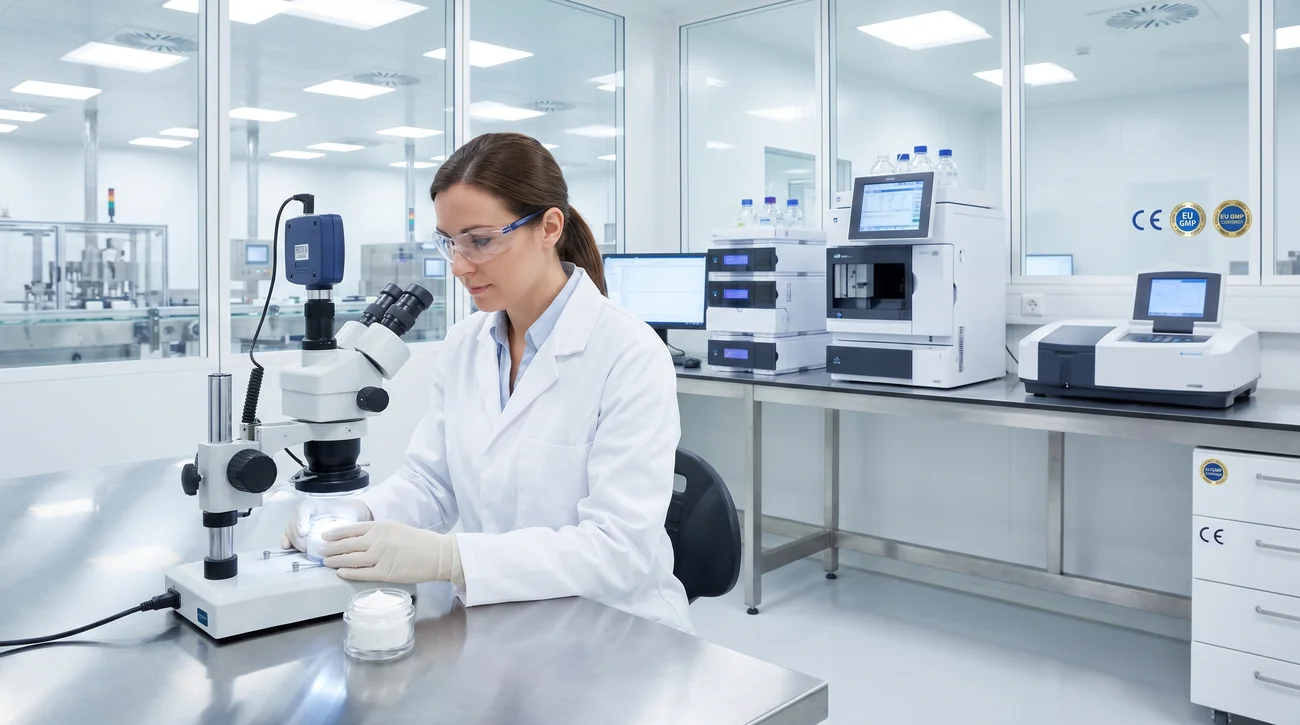
When brands outside Europe decide where to manufacture their cosmetics, they typically consider three regions: China, Southeast Asia, and Europe. The price difference is real. European manufacturing generally costs more per unit at small volumes. But for brands that are building a product they plan to stand behind long-term, the reasons to source cosmetics from Europe go well beyond price. This guide explains what those reasons are, in practical terms, and what to expect when you source cosmetics from Europe for the first time.
Table of Contents
EU Cosmetics Regulation: 1,300+ Banned Ingredients
The most concrete reason to source cosmetics from Europe is the regulatory baseline. The EU Cosmetics Regulation (EC No 1223/2009) prohibits or restricts over 1,300 substances from use in cosmetic products. By comparison, the US FDA has restricted approximately 11 ingredients under its current framework. Australia and Canada sit somewhere in between, but neither matches EU stringency.
What this means in practice: when you source cosmetics from Europe, the formulas you receive are already compliant with the strictest cosmetics regulatory environment in the world. Ingredients that have been flagged in scientific literature (parabens at certain concentrations, formaldehyde-releasing preservatives, certain UV filters) are either restricted or prohibited entirely. Your manufacturer is not making these trade-offs to reduce costs; the law does not permit them to.
For brands entering the US, UK, Australian, or Gulf markets, launching with a formula manufactured under EU regulation gives you a credible compliance story from day one. “Manufactured in the EU under EC 1223/2009” is a substantiable claim, not a marketing phrase.
Mandatory GMP Certification: ISO 22716
Every EU cosmetics manufacturer is legally required to operate under Good Manufacturing Practice (GMP) as defined by ISO 22716. This is not optional or self-certified; it is a legal obligation enforced at the member state level. GMP covers facility standards, equipment calibration, batch documentation, quality control procedures, and supplier qualification. A batch that fails to meet these standards cannot legally be placed on the EU market.
When you source cosmetics from Europe, you receive a Certificate of Conformity and, on request, a GMP Certificate. These documents are increasingly required by distributors and import authorities worldwide, including US Customs under MoCRA, Australian TGA assessments, and Gulf Cooperation Council import procedures. Having them included as standard from your European manufacturer removes a step from your compliance workflow.
COSMOS and NATRUE: Organic Standards the World Recognises
If your brand targets the clean beauty or organic segment, sourcing from Europe gives you access to the two internationally recognised organic cosmetics certification standards: COSMOS (governed by ECOCERT, BDIH, Cosmebio, Soil Association, and ICEA) and NATRUE. Both are recognised in the US, UK, Japan, Australia, and the Gulf markets as credible third-party organic certifications.
The “USDA Organic” certification, by contrast, applies to food and agriculture; it does not map directly to cosmetic formulas. Brands selling internationally find that COSMOS Organic provides a cleaner, more globally consistent story for organic cosmetic claims than domestic alternatives in non-EU markets. European manufacturers with COSMOS-certified production capability are your direct route to this certification.
Ingredient Traceability and Transparency
EU manufacturers operate within a supply chain traceability framework. Every ingredient must be documented, its supplier, batch number, Certificate of Analysis, and compliance status under EC 1223/2009. This documentation is maintained as part of the Product Information File (PIF), which must be available to regulatory authorities on request.
For brands, this matters because end consumers and retail buyers are increasingly requesting ingredient transparency. If a retailer asks for your full ingredient sourcing documentation, your EU manufacturer already holds it. If a market authority requests your PIF for import clearance, it exists and is structured to regulatory standards. This level of documentation is not standard in all manufacturing regions.
Export Documentation Included as Standard
One practical advantage that brands discover when they source cosmetics from Europe is the documentation package that comes with each shipment. Reputable EU manufacturers provide as standard:
- Certificate of Analysis (COA): batch-specific testing results confirming the product meets its specification.
- Safety Data Sheet (MSDS/SDS): required for customs classification and import clearance in most markets.
- Free Sale Certificate: confirms the product is legally manufactured and sold in the EU, required for import registration in many markets including the Gulf, Southeast Asia, and parts of Latin America.
- GMP Certificate: confirms manufacturing under ISO 22716, increasingly required for US and Australian import compliance.
These documents are not extras; they are part of what you pay for when you source cosmetics from Europe from a legitimate manufacturer. They are what allow you to clear customs in markets that have documentation requirements, and they are what gives your product credibility with regulated distribution channels.
European vs. Asian Cosmetics Manufacturers: A Realistic Comparison
The decision to source cosmetics from Europe versus Asia is not a simple cost comparison. Here is a realistic breakdown of the key differences:
- Regulatory compliance: EU manufacturers operate under EC 1223/2009 and mandatory GMP. Asian manufacturers operate under varying national regulations, some of which permit ingredients restricted in the EU, US, and UK.
- Documentation: EU manufacturers produce full PIFs, COAs, and Free Sale Certificates as part of standard operation. Documentation standards vary significantly among Asian manufacturers.
- MOQ: Many European manufacturers operate at MOQ 500 units, comparable to or lower than reputable Asian OEM manufacturers for branded private label.
- Lead times: EU shipping to the US, UK, or Australia is 5–15 days by air. Comparable to Southeast Asia, faster than China for air; longer by sea but with better documentation.
- Unit cost: European manufacturing typically costs 10–30% more per unit than Asian alternatives at equivalent volumes. The gap narrows significantly when documentation, compliance, and import failure risk are factored in.
For brands positioning in the premium, clean beauty, or health-conscious segment, where “EU-made” is part of the product story, the unit cost premium is often justified and recoverable through retail pricing.
The “EU-Made” Premium Signal for Your Brand
“EU-made” functions in the global cosmetics market similarly to “Made in Germany” in automotive or “Made in Italy” in fashion. It signals a quality standard, a regulatory environment, and a production tradition that has measurable value in consumer perception, particularly in the US, UK, Gulf, and Australian markets.
Survey data consistently shows that consumers in premium segments are willing to pay more for products manufactured in the EU, and that “European formulation” is a meaningful purchase signal in the skincare and haircare categories. For brands building long-term equity, the manufacturing origin is part of the brand asset, not just a logistics decision.
How to Start Working with a European Cosmetics Manufacturer
The process of sourcing cosmetics from Europe is straightforward. You submit a product brief, receive a quotation, approve samples, and move to production. Most reputable EU manufacturers offer both white label (adapting existing formulas, 1–2 weeks to sample) and custom OEM formulation (4–8 weeks to first prototype). Minimum order quantities typically start at 500 units per product, making European manufacturing accessible to smaller brands and startups, not just large companies.
Cosmetic Lab is an EU-certified cosmetics manufacturer based in Riga, Latvia, operating since 2005 with export to 20+ countries. We provide full export documentation, DDP delivery options, and support for brands entering the US, UK, Australian, and Gulf markets. Our formulation development services and white label catalogue cover skincare, haircare, bath and body, solid cosmetics, and specialist formats. Contract manufacturing and private label are available from MOQ 500 units.
Frequently Asked Questions
Is it more expensive to source cosmetics from Europe than from China?
Unit costs at equivalent volumes are typically 10–30% higher for European manufacturing. However, the comparison should include documentation costs, import compliance risk, and return logistics if a shipment fails to meet import standards. For brands selling in premium channels or positioning on clean beauty credentials, the retail pricing premium typically offsets the manufacturing cost difference.
Do EU-manufactured cosmetics comply with US FDA requirements?
EU-manufactured cosmetics comply with EC 1223/2009, which is more stringent than current US FDA requirements in most areas. Under MoCRA (Modernization of Cosmetics Regulation Act, 2022), US importers must register their facilities and maintain safety substantiation. EU manufacturers operating under GMP and with full PIFs and COAs are well-positioned to meet these requirements. Your manufacturer should be able to provide the documentation needed for MoCRA compliance.
What is the minimum order when sourcing cosmetics from a European manufacturer?
MOQ varies by manufacturer and product type. When you source cosmetics from Europe, many manufacturers, including Cosmetic Lab, offer MOQ from 500 units per product for both white label and custom OEM formulations. This is comparable to reputable manufacturers in other regions and makes European manufacturing viable for startups and small brands, not only large buyers.
Can a European manufacturer ship directly to my country?
Yes. Reputable EU cosmetics manufacturers export globally and can arrange DDP (Delivered Duty Paid) shipping to the US, UK, Australia, Canada, the Gulf region, and other markets. They provide all required export documentation (COA, MSDS, Free Sale Certificate, GMP Certificate) to support import clearance in your market.
Looking to source cosmetics from Europe for your brand? Contact Cosmetic Lab below; we respond to enquiries within 2 business days with a preliminary quotation and sample plan. You can also review our full certifications page for details on our COSMOS, NATRUE, ISO 9001, and GMP standards.
Further reading: How to Import Cosmetics from Europe: Step-by-Step Guide | White Label vs Private Label vs OEM Cosmetics