White Label vs Private Label vs OEM Cosmetics: Which Model Is Right for Your Brand?
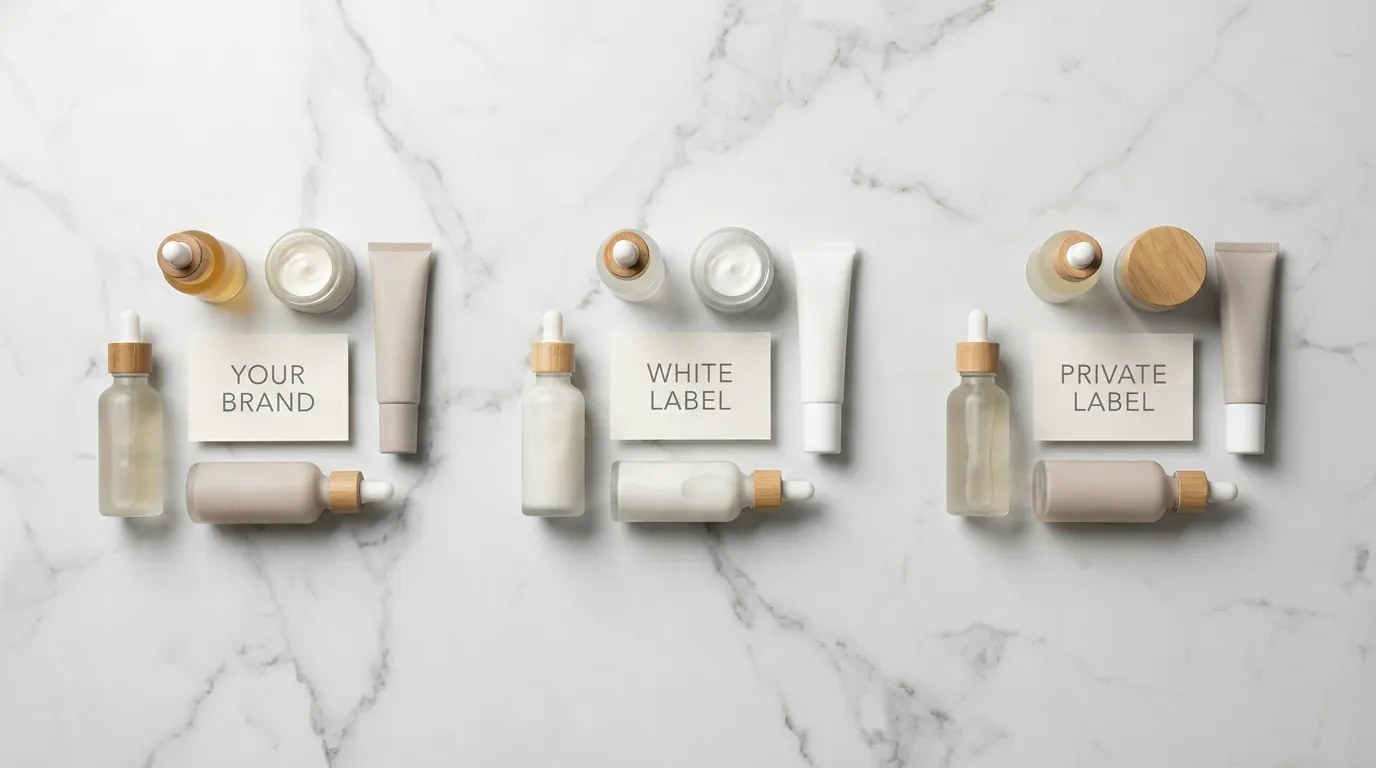
White label vs private label cosmetics: if you are planning to launch a beauty brand or expand an existing range, choosing the right manufacturing model is one of the first and most consequential decisions you will make. The three terms (white label, private label, and custom OEM) are used interchangeably across the industry, but they describe meaningfully different production arrangements with different implications for speed, cost, exclusivity, and control over your product.
This white label vs private label cosmetics guide explains what each model means in practice, and how to decide which is the right route for your brand: based on your timeline, budget, target market, and whether formula exclusivity matters commercially.
Table of Contents
The Three Models: Definitions
Before comparing them, it helps to have clean definitions. Here is what each term means in a manufacturing context:
White Label Cosmetics
White label cosmetics are products manufactured from a supplier’s existing, pre-tested formula catalogue. The manufacturer produces the formula; you apply your brand’s label and packaging. The formula is not exclusive: other brands may purchase and sell the same formulation under their own label. Speed and cost efficiency are the primary advantages. You skip formula development entirely and move straight to packaging, branding, and launch.
Private Label Cosmetics
Private label cosmetics follow the same basic model: you brand products from the manufacturer’s existing formula catalogue, but the term often implies a closer commercial relationship, sometimes including minor formula adjustments (fragrance, colour, texture), more tailored packaging options, or a degree of exclusivity within a specific market or retail channel. In practice, the operational difference between white label and private label is small. Both models start from the manufacturer’s existing formulations. The distinction is more commercial than technical.
Custom OEM Formulation
OEM stands for Original Equipment Manufacturer. In cosmetics, custom OEM means the manufacturer develops a formula specifically for your brand, from scratch, to your specification. You own the intellectual property, the formula is exclusive to your brand, and it cannot be sold to other clients. The trade-off is time and cost: custom development adds 4–8 weeks of R&D and stability testing before production can begin, and upfront development costs are higher than white or private label.
White Label vs Private Label: Is There Actually a Difference?
This is the most common source of confusion in cosmetics manufacturing, and the honest answer is: not much, at least not operationally.
Both white label and private label cosmetics draw from the manufacturer’s existing formula library. Both models involve you selecting a formula, applying your brand’s packaging and labelling, and going to market. The formula in both cases belongs to the manufacturer, not to you. The same formula may be sold to multiple brands.
Where a meaningful difference can exist:
- Customisation depth: Private label arrangements sometimes include minor formula adjustments changing the fragrance, adding a branded active ingredient at a low concentration, adjusting colour or viscosity. True white label is typically off-the-shelf with no modification.
- Exclusivity: Some private label agreements include territorial or channel exclusivity: the manufacturer agrees not to sell the same formula to a direct competitor in your market. White label is generally non-exclusive by definition.
- Branding depth: Private label often involves more manufacturer involvement in packaging design and label development. White label is closer to a commodity transaction.
In reality, different manufacturers use these terms differently. One supplier’s “private label” is another’s “white label”. When evaluating a manufacturer, the questions that matter are: Is the formula exclusive to me? Can I adjust it? What documentation and certifications come with it? The label on the service matters less than the answers to those questions.
When White Label or Private Label Is the Right Choice
The white label and private label route makes the most sense when: you need to launch quickly, within weeks rather than months; you are testing a new product category and want to validate demand before committing to custom development; formula exclusivity is not commercially important because your brand differentiation comes from marketing and distribution rather than a unique formula; you are a retailer or distributor adding a house brand to an existing portfolio; or your budget does not currently support the higher upfront cost of custom development.
Custom OEM Formulation: When You Need Something Unique
Custom OEM formulation is the right choice when the formula itself is part of your brand’s competitive advantage, when what is inside the product is as important as what is on the label.
Brands built around a specific active ingredient, brands making specific performance claims that require a formula engineered to deliver them, and brands in regulated or professional channels where formula uniqueness is a credibility signal all have genuine reasons to invest in custom development. Custom OEM is also appropriate when you intend to scale and protect your product over time. If your formula is exclusive, a competitor cannot simply go to the same manufacturer and order the same product. With white or private label, they can, and in competitive categories, this matters.
What Custom OEM Formulation Involves
A custom formulation project starts with your brief: target texture, key actives, performance claims, target market, and reference products. The manufacturer’s R&D team develops a prototype, which you evaluate and iterate until approved. In parallel, stability testing and safety assessment are completed to EU regulatory standards. Only then does full production begin.
Realistic timeline from brief to finished goods: 8–14 weeks. For brands with a hard launch date, this timeline needs to be planned backwards from the deadline, not treated as something to compress when it becomes inconvenient. Stability testing in particular cannot be shortened without compromising the validity of the data.
The IP Question
Formula intellectual property is the clearest dividing line between OEM and white or private label. With custom OEM, the formula is yours. The manufacturer cannot sell it to another client. You can change manufacturers and take the formula with you (subject to contract terms). This is a genuine commercial asset, particularly for brands in premium or professional markets where the formula is part of the product story.
With white or private label, the IP stays with the manufacturer. If you change supplier, you change formula which means reformulating or risking product inconsistency. For most consumer brands, this is an acceptable trade-off. For brands where the formula is central to the value proposition, it is not.
Side-by-Side Comparison: All Three Models
The table below summarises the key differences across all three manufacturing models across the dimensions that most affect a brand’s launch strategy:
| Factor | White label | Private label | Custom OEM |
|---|---|---|---|
| Formula origin | Manufacturer’s existing catalogue | Manufacturer’s existing catalogue (minor adjustments possible) | Developed from scratch to your spec |
| Formula exclusivity | Non-exclusive | Sometimes semi-exclusive by market or channel | Fully exclusive |
| IP ownership | Manufacturer | Manufacturer (usually) | Your brand |
| Customisation | Minimal label and packaging only | Limited fragrance, colour, minor actives | Full texture, actives, claims, format |
| Time to first sample | 1 week | 1–2 weeks | 4–8 weeks |
| Time to finished goods | 4–6 weeks | 4–8 weeks | 8–14 weeks |
| Upfront cost | Low | Low–medium | Medium–high |
| MOQ (typical) | 500 units | 500 units | 500 units |
| Best for | Fast launch, range testing, cost efficiency | Branded house ranges, retail house brands | Unique positioning, IP-driven brands, professional channels |
| Formula portable to new manufacturer | No | No (usually) | Yes (subject to contract) |
One factor not shown in the table: regulatory documentation. All three models, when manufactured by an EU-certified facility, produce the same core export documentation package: Certificate of Analysis, MSDS/SDS, Free Sale Certificate, and Product Information File. The regulatory standing of the finished product does not depend on which manufacturing model you chose.
Which Model Is Right for Your Brand?
The right model depends on four factors: timeline, budget, the commercial importance of formula exclusivity, and your brand’s stage of development.
Choose White Label or Private Label if:
- You need to launch within 6–8 weeks.
- You are launching for the first time and want to validate demand before investing in custom development.
- Your brand differentiation is in marketing, positioning, and customer experience, not in a unique formula.
- You are a retailer, e-commerce operator, or distributor creating a house brand.
- Budget is a primary constraint white label eliminates development costs entirely.
Choose Custom OEM if:
- Your formula is part of your brand story a specific active, a proprietary blend, or a texture that no standard catalogue formula delivers.
- You intend to make specific performance claims that require a formula engineered to support them.
- You are in a professional or premium channel where formula exclusivity is a credibility requirement.
- You have a hard requirement for formula IP ownership for investor, licensing, or exit reasons.
- You have 10–16 weeks before your launch date and can absorb the development timeline.
- You have already validated demand with white label and are ready to differentiate with an exclusive formula.
A Common Progression
Many successful cosmetics brands follow a staged approach: launch with white or private label to validate demand and build revenue, then invest in custom OEM formulation for hero products once the market has been tested. This is commercially rational it avoids the risk of investing in a custom formula for a product that the market does not respond to. White label provides the speed and cost efficiency to test; OEM provides the differentiation to defend a position once the opportunity is confirmed.

What EU Certification Means for All Three Models
Regardless of which manufacturing model you choose, sourcing from an EU-certified manufacturer provides a regulatory foundation that most other regions cannot match. The EU Cosmetics Regulation (EC 1223/2009) mandates safety assessments by a qualified safety assessor, stability testing, a complete Product Information File (PIF), and GMP-compliant manufacturing for every product placed on the EU market.
For brands distributing internationally, EU-made status is a commercial advantage across all three models. Import registration in Southeast Asia, the GCC states, Central Asia, and most other regulated markets is smoother when a product comes with a Free Sale Certificate from the EU, a Certificate of Analysis, and ISO 22716 GMP documentation. These are standard with any EU manufacturer for any manufacturing model.
EU certification also matters for organic and natural claims. If you are pursuing COSMOS Organic, COSMOS Natural, or NATRUE certification whether white label or custom you need a manufacturer that holds those certifications and manufactures under their scope. For more on what certification covers, see our certifications page and our guide to organic cosmetics private label.
Common Mistakes When Choosing a Manufacturing Model
Choosing OEM when white label would have worked
Custom OEM is expensive and slow relative to white label. Brands that invest in custom development before validating demand sometimes find themselves with an exclusive formula for a product that does not sell. If your differentiation is in branding and distribution rather than in the formula itself, white label is almost always the faster and lower-risk path to market validation.
Assuming white label means lower quality
White label formulas from a certified EU manufacturer are safety-assessed, stability-tested, and compliant with EU Cosmetics Regulation the same regulatory standard that applies to any custom formula. The quality of the manufacturing process does not depend on whether the formula is from a catalogue or custom-developed. What white label cannot give you is formula exclusivity. Quality is a separate question entirely.
Ignoring the timeline implications of custom development
Brands consistently underestimate how long custom formulation takes. A realistic timeline from brief to finished goods is 8–14 weeks. Stability testing alone which cannot be compressed typically takes 4–6 weeks of concurrent testing. Brands that start custom development 8 weeks before a target launch date will miss it. If your launch date is fixed, white label is almost certainly the only viable route.
Confusing the label with the substance
Whether a manufacturer calls their service “white label” or “private label” tells you very little. What matters is whether the formula is exclusive, whether it can be modified, what documentation comes with it, and what certifications the manufacturer holds. Ask those questions directly do not assume the answers from the terminology.
How Cosmetic Lab Works Across All Three Models
For brands comparing white label vs private label cosmetics options, Cosmetic Lab offers all three manufacturing models from our EU-certified facility in Riga, Latvia operating under ISO 22716 GMP, COSMOS Organic, COSMOS Natural, and NATRUE certifications since 2005.
- White label cosmetics: 3,000+ ready-made formulations across skincare, haircare, body care, solid cosmetics, spa and bath, men’s care, and baby and sensitive. Sample in 1 week, finished goods in 4–6 weeks. MOQ 500 units.
- Private label cosmetics: Formula selection from our catalogue with deeper brand integration: packaging sourcing, artwork review, and label compliance for your target markets.
- Custom OEM formulation: In-house R&D develops your formula from scratch. Exclusive IP, prototype in 4–8 weeks, full production from 500 units. Specialities include solid cosmetics, spa collections, natural and organic, and hair care.
All three models include full export documentation COA, MSDS/SDS, Free Sale Certificate, and Product Information File and we ship to 20+ countries across Europe, the Middle East, Southeast Asia, Central Asia, and North America. See our EU cosmetics manufacturer worldwide page for export details. Further reading: Why Source Your Cosmetics from a European Manufacturer and How to Import Cosmetics from Europe. For full OEM and contract production capabilities, see our cosmetics contract manufacturing page.
To discuss which model fits your project, submit your brief below and we will respond within 2 business days.